Artificial Intelligence: How AI Is Changing Everyday Technology

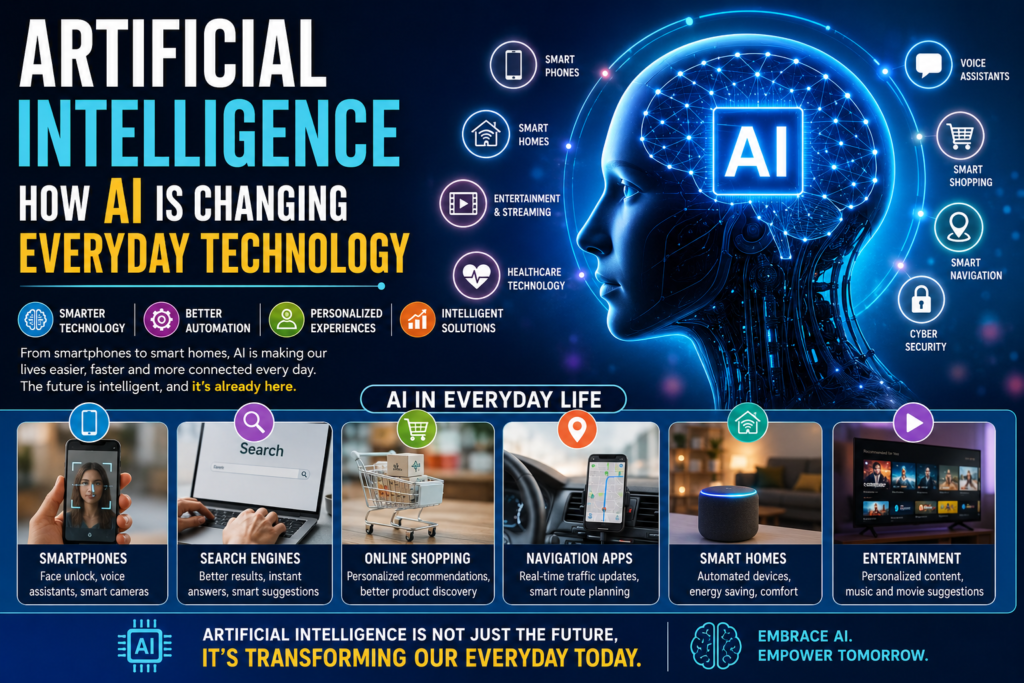
Artificial Intelligence: How AI Is Changing Everyday Technology
Artificial intelligence, commonly called AI, is no longer something that exists only in science-fiction movies or advanced research laboratories. It has gradually become part of everyday technology, often working quietly in the background while people use smartphones, search engines, streaming platforms, navigation apps, online stores, smart devices, and digital assistants.
Many people interact with AI several times a day without realizing it. When a phone recognizes a face, a navigation app suggests a faster route, a streaming service recommends a movie, or an email service filters unwanted messages, artificial intelligence may be involved.
The rapid development of AI is changing how technology works and how people interact with digital services. Instead of simply following fixed instructions, many modern systems can analyze information, recognize patterns, make predictions, and respond to users in increasingly useful ways.
This does not mean AI is replacing every traditional technology. Instead, it is becoming an additional layer that helps software and devices understand information and automate certain tasks.
In this article, we will look at how artificial intelligence is changing everyday technology, where people encounter it, its benefits and limitations, and what its future may look like.
What Is Artificial Intelligence?
Artificial intelligence refers to computer systems designed to perform tasks that normally require some form of human intelligence.
These tasks can include recognizing images, understanding language, identifying patterns, making predictions, generating content, and helping users make decisions.
Machine learning is one of the major technologies behind modern AI. Instead of programming every possible response manually, machine-learning systems can learn patterns from data and use those patterns to produce predictions or outputs.
For example, an email service can analyze characteristics of unwanted messages and use those patterns to identify similar messages in the future.
Modern AI can be extremely useful, but it is important to remember that AI systems are not automatically correct. Their results depend on the information, design, training, instructions, and context available to them.
1. AI Is Making Smartphones Smarter
Smartphones are among the clearest examples of AI becoming part of everyday technology.
Modern phones can use AI for features such as facial recognition, voice commands, photography, translation, predictive text, battery management, and personalized suggestions.
For example, computational photography can analyze a scene and automatically adjust aspects of an image. A smartphone camera may identify a face, landscape, food, or low-light environment and apply processing designed to produce a better-looking photograph.
AI can also make typing more convenient. Predictive text systems analyze the words a person has already entered and suggest possible next words or corrections.
Voice assistants are another familiar example. Users can speak commands instead of typing them, allowing them to search for information, set reminders, control compatible devices, or perform other tasks.
These features demonstrate how AI is changing smartphones from simple communication devices into more personalized digital tools.
2. AI Is Transforming Search and Online Information
Search technology has also changed significantly with the development of AI.
Traditional search systems primarily matched queries with relevant web pages. Modern search systems can use AI to better understand the meaning behind a question, identify relationships between concepts, and provide more useful results.
This is particularly helpful when users type conversational or complicated questions.
AI can also help users summarize information, translate text, identify important concepts, and interact with digital information using natural language.
However, users should not assume that every AI-generated answer is automatically accurate. AI systems can sometimes misunderstand a question, use incomplete information, or produce incorrect statements.
For important topics, checking information against reliable and authoritative sources remains a sensible habit.
3. AI Is Changing Online Shopping
Artificial intelligence is becoming increasingly common in e-commerce.
Online stores can use algorithms to analyze products, browsing behavior, search activity, and purchasing patterns to provide personalized recommendations.
For example, after viewing several products, a shopper may receive suggestions for related items.
AI can also help online retailers organize product information, improve search functions, identify unusual transactions, estimate demand, and provide automated customer support.
For consumers, personalization can make it easier to discover products that match their interests.
At the same time, personalization means people should remain aware of how their online activity may influence the content and recommendations they see.
A recommendation is not necessarily an objective indication that a particular product is the best choice.
4. AI Is Improving Navigation and Maps
Navigation applications have become another important part of everyday life where AI and related data-processing technologies can be useful.
A navigation service can analyze information such as road conditions, historical traffic patterns, reported incidents, and other available data to help estimate travel times and suggest routes.
Instead of simply showing a fixed map, modern navigation systems can dynamically respond to changing conditions.
For example, if traffic becomes heavier on one road, a navigation system may recommend an alternative route.
This can save time and make daily travel more convenient.
AI-supported navigation can also assist with location search, estimated arrival times, route planning, and understanding natural-language requests.
5. AI Is Entering Smart Homes
Smart-home technology is another area where artificial intelligence is becoming increasingly visible.
Smart speakers, cameras, thermostats, appliances, and other connected devices can use software and AI-based features to respond to commands or recognize patterns.
A smart home system may learn preferred settings or use sensors to automate certain activities.
For example, connected devices can be programmed to adjust lighting or temperature based on schedules, occupancy, or user preferences.
AI can also help smart cameras identify objects or unusual activity.
However, convenience should be balanced with privacy and security. Smart devices can collect information about homes and user behavior, so consumers should review privacy settings, use strong passwords, install security updates, and understand what information their devices collect.
6. AI Is Personalizing Entertainment
Streaming platforms have changed how people discover movies, television programs, music, podcasts, and other digital content.
Recommendation systems can analyze viewing or listening patterns and identify content that may be relevant to a particular user.
This is one reason two people using the same platform can receive very different recommendations.
AI can help platforms organize enormous libraries of content and make discovery easier.
The advantage is convenience: users may find something interesting without manually searching through thousands of options.
The disadvantage is that recommendation systems can influence what people see repeatedly. As a result, it can be useful to occasionally explore content outside automatically generated recommendations.
7. AI Is Helping With Communication
Artificial intelligence is also changing everyday communication.
Modern communication tools can provide automatic translation, spelling suggestions, grammar assistance, transcription, text prediction, and speech recognition.
These features can make digital communication faster and more accessible.
For example, speech-to-text technology allows users to dictate messages instead of typing them. Translation tools can help people understand information written in another language.
AI-powered writing tools can also assist with organizing ideas, improving clarity, or generating initial drafts.
However, users should review AI-assisted writing carefully, particularly when communicating professionally or sharing factual information. AI-generated text can contain mistakes or inappropriate wording.
8. AI Is Supporting Digital Security
Cybersecurity is another important area where AI can assist technology systems.
Digital services generate enormous amounts of activity every day. Security systems can analyze patterns and identify behavior that appears unusual.
AI-based systems may help detect suspicious logins, unusual transactions, malware patterns, or other potential security problems.
The technology can help security teams process large quantities of information more quickly.
At the same time, AI can also be used by attackers to create more convincing scams and automated attacks. This means cybersecurity will remain an ongoing competition between defensive and offensive technologies.
For everyday users, basic security practices remain important. Strong passwords, multi-factor authentication, software updates, and caution with unexpected messages can reduce many common risks.
9. AI Is Changing Photography and Video
AI has significantly influenced digital photography and video technology.
Modern cameras and editing applications can automatically identify subjects, improve lighting, reduce noise, sharpen images, remove unwanted elements, and apply other processing.
Some devices can recognize scenes and optimize settings automatically.
AI-powered editing tools can also make advanced adjustments easier for people who have little experience with professional editing software.
However, increasingly powerful editing technology also creates questions about authenticity.
As synthetic images and videos become easier to create, people may need to become more careful about verifying visual information found online.
A realistic-looking image is not necessarily proof that an event actually happened.
10. AI Is Supporting Healthcare Technology
AI is also being explored and used in various areas of healthcare technology, including medical imaging, administrative systems, research, monitoring, and data analysis.
In some situations, AI can help professionals process large amounts of information or identify patterns that may deserve closer attention.
However, healthcare is a high-stakes field, and AI should not be treated as an automatic replacement for qualified medical professionals.
An AI-generated health answer can be incomplete or incorrect.
For personal health decisions, people should rely on qualified healthcare professionals and appropriate medical sources rather than treating an AI system as a diagnosis tool.
Benefits of AI in Everyday Technology
The growing use of artificial intelligence offers several potential benefits.
Greater convenience
AI can automate repetitive tasks and make digital services easier to use.
Personalization
Technology can adapt recommendations, settings, and experiences to individual users.
Faster information processing
AI can analyze large quantities of information much faster than a person could manually process it.
Improved accessibility
Speech recognition, translation, text assistance, and other AI-supported tools can make technology easier for more people to use.
Automation
Routine digital tasks can sometimes be performed automatically, allowing users to spend more time on other activities.
These benefits explain why AI is becoming an important part of modern technology.
What Are the Limitations of AI?
AI is powerful, but it is not perfect.
One major limitation is that AI systems can produce incorrect information. A confident-looking answer can still be wrong.
AI systems can also reflect problems present in the data or design used to build them.
Privacy is another consideration. Some AI-powered services rely on large amounts of data, so users should understand how their information is collected and processed.
There are also concerns about job changes, misinformation, security, copyright, and responsible use.
For these reasons, AI should be viewed as a technology that requires thoughtful use rather than as an infallible replacement for human judgment.
How AI May Change Everyday Technology in the Future
AI is likely to become even more integrated into everyday devices and services.
Future smartphones may offer more personalized assistance. Cars may use increasingly advanced driver-support systems. Smart-home devices may coordinate more efficiently. Translation may become more natural, and software applications may become more conversational.
AI could also make technology more proactive.
Instead of waiting for users to give every instruction, systems may increasingly recognize context and suggest useful actions.
However, greater automation will also increase the importance of privacy, security, transparency, and user control.
The best future for AI is not necessarily one where technology makes every decision for people. A more useful direction may be technology that handles appropriate routine tasks while keeping people informed and in control.
How to Use AI Responsibly
As AI becomes more common, users can develop a few simple habits.
First, verify important information instead of accepting every AI-generated response immediately.
Second, avoid entering sensitive personal information into unfamiliar AI services.
Third, review privacy settings and understand what data an application collects.
Fourth, keep devices and software updated.
Finally, use AI as a tool that supports human decision-making rather than assuming it is always correct.
Frequently Asked Questions
What is artificial intelligence?
Artificial intelligence is technology that enables computer systems to perform tasks associated with human intelligence, such as recognizing patterns, understanding language, making predictions, and analyzing information.
How is AI used in everyday life?
AI can be found in smartphones, search engines, navigation applications, online shopping, streaming services, smart-home devices, photography tools, communication software, and cybersecurity systems.
Is AI the same as machine learning?
Not exactly. Machine learning is one major approach used to build AI systems. It allows systems to identify patterns from data and use those patterns to make predictions or decisions.
Can AI make mistakes?
Yes. AI systems can produce incorrect, incomplete, or misleading information. Users should verify important information, especially when decisions have serious consequences.
Is artificial intelligence safe?
AI itself is a technology, and its safety depends on how it is designed, deployed, and used. Privacy, cybersecurity, misinformation, and responsible use are important considerations.
Will AI replace all human jobs?
There is no simple answer. AI is likely to automate some tasks and change many types of work, while also creating new roles and requiring new skills. The impact will vary across industries and occupations.
How can I use AI responsibly?
Use AI as an assistant rather than an unquestionable authority, verify important information, protect personal data, review outputs carefully, and understand the privacy settings of the services you use.
Final Thoughts
Artificial intelligence is already changing everyday technology in ways that many people experience without thinking about the technology behind them.
From smartphones and navigation applications to online shopping, entertainment, smart homes, communication, photography, and cybersecurity, AI is helping digital systems analyze information and respond to users in increasingly sophisticated ways.
The biggest benefit of AI may not be that it makes technology completely autonomous. Instead, its value can come from making technology more useful, accessible, personalized, and efficient.
At the same time, AI has limitations. It can make mistakes, raise privacy concerns, and create new challenges involving security, employment, misinformation, and responsible technology use.
For consumers, the best approach is neither to fear AI nor to assume that it is always correct. Understanding what AI can do, recognizing its limitations, protecting personal information, and verifying important information can help people use the technology more confidently.
As artificial intelligence continues to develop, it will likely become an even more familiar part of everyday digital life. The goal should be to use that technology thoughtfully while keeping human judgment, transparency, privacy, and user control at the center.
